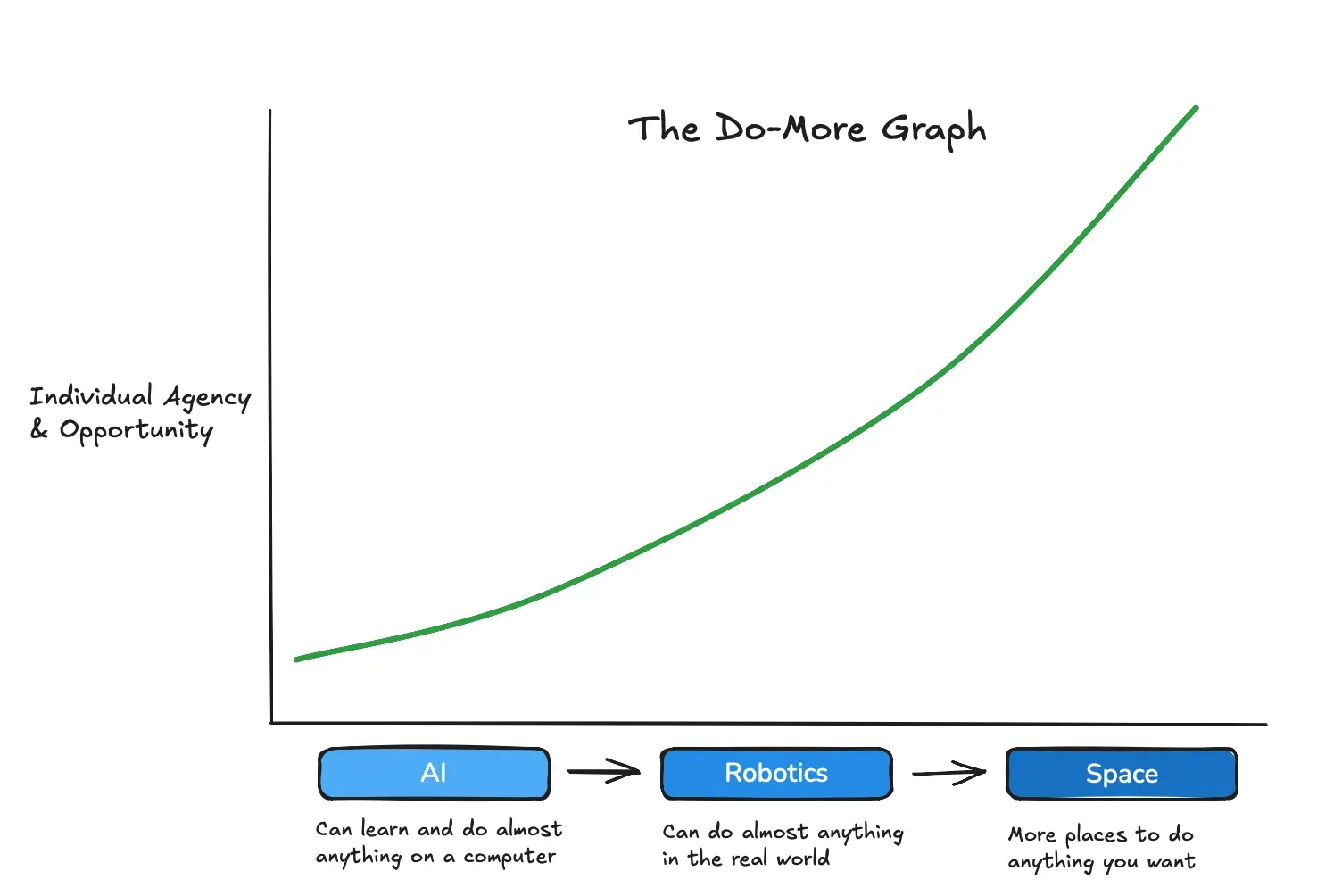
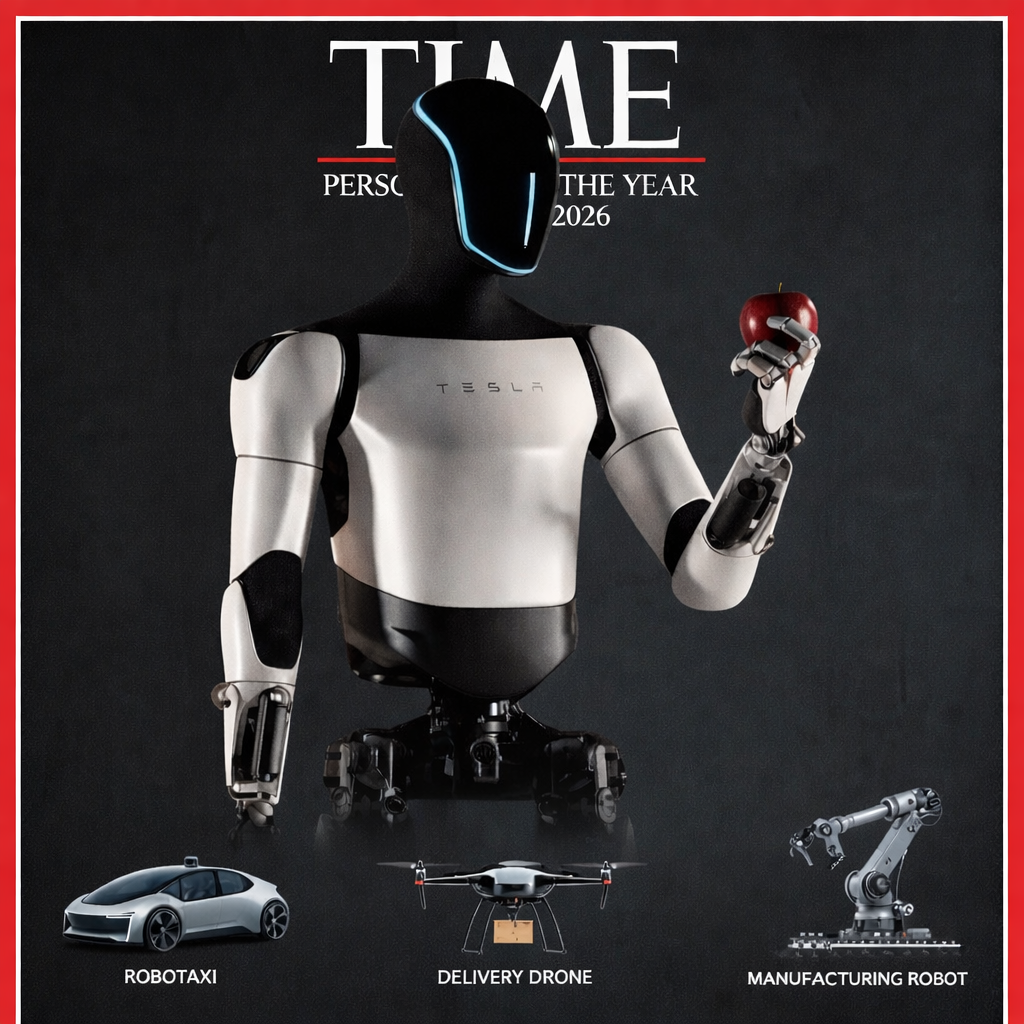
If 2025 was the year of AI, 2026 should be the year of the robot. Much of the software era was defined by near zero marginal costs to acquire and serve a customer. The next paradigm will be creating near zero marginal physical networks, uniquely enabled by robotics.
AI has a branding issue
Before getting to robots, we need to look at how AI is being perceived in the market and why that is wrong. The current framing is all too similar to the internet in 1995 rather than say 2010.
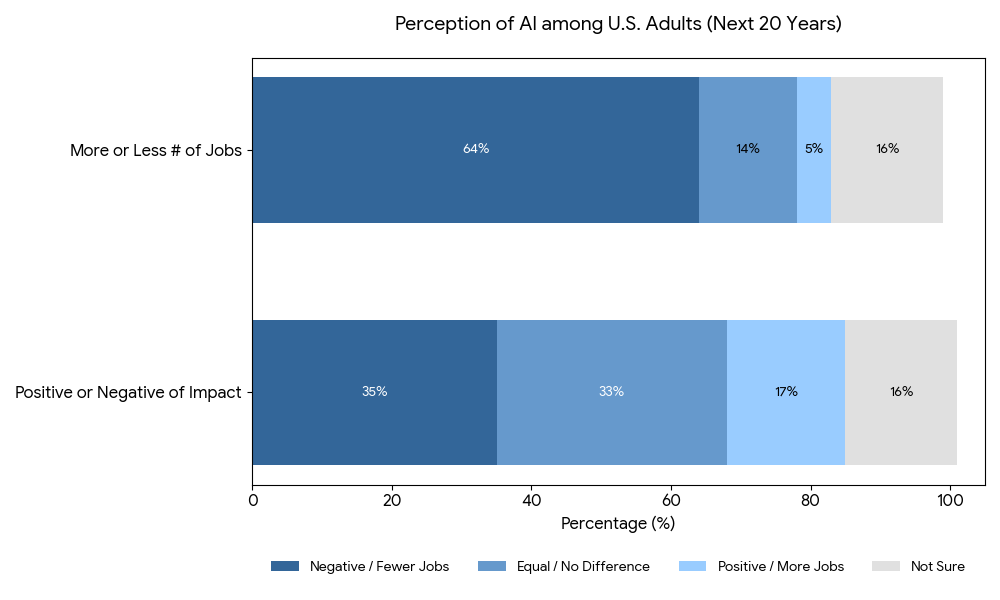
According to a Pew Research study, only 17% of normal Americans view AI as a positive. And thats likely have a lot to do with 64% of normal Americans believing there will be less jobs in the future.
As AI does increasingly all things digital, then the marginal value of digital goods and services seemingly also increasingly declines. Now, you could argue Jevon’s paradox and that this will drive the need for more digital-based services, but I’d wager that less than 17% of those U.S. Adults know of Jevon’s paradox and even less will give you the time to explain it without thinking you’re a smug know it all dipshit.
A simple framing currently being offered to support the good of AI is growth / economy and beat China. But the problem is it is really easy to imagine how AI can be applied to the tasks we do today and a lot harder to imagine for tasks that we either don’t do yet or are too complicated for most to understand. It leads to fear, uncertainty, and doubt for how a family will provide for itself and their future.
In contrast, the internet and mobile was all about connection, consumption, and extension. The general population was always going to be pro more connection and more consumption. Despite fears of newspapers being obsolete and so on, most were eager to use it because it made the future more engaging, more fun.
AI is different — it is for doing things. Currently, we consume primarily through a chat / pull interface because we’re trying to accomplish something. You have to benefit from doing things better/faster to buy into the upside. Its a Principle-Agent issue.
What needs to be sold is a future. Chamath’s social dividends concept, akin to Carnegie’s 2,500 public libraries, is a one step in the right direction. It needs to be a future where an individual’s agency increases; one with more opportunity to enjoy life, liberty, and the pursuit of happiness. And really that’s just a bunch of “jobs” doing stuff that sounds interesting to your socio-economic level of friends and girls/boys. And it needs to be fun.
That future and those “jobs” are toward the stars and, for better and for worse, that story is being told by this era’s greatest science fiction writer: Elon Musk.
What future is Elon betting on?
When you listen to a smart investor talk about Elon, usually you will hear the quote “never bet against Elon.” So what future is Elon betting on exactly?
For all the shade he gets (or invites), he has to be one of the most transparent leaders in history. Since the early 2000s or before, Elon’s goal has been to make humanity multi-planetary. He post unfiltered thoughts multiple times a day on X. And yet, as we enter the next era of that journey, it seems that the collective we have lost the plot of Elon’s narrative despite it being so obvious, and, going into 2026, tangible. Look at his investments / companies:
- SpaceX — Space infrastructure (transportation, communications)
- Tesla — Vertically integrated robotics and energy company
- xAI — Applied Intelligence (R&D, infrastructure, and services)
- X Corp — social infrastructure
- Boring Company — Terraforming capability and “colossus” class robotics
- Neurolink — human-machine orchestration interface
First space. You need to build economically viable transportation to space. Without viable & scalable rockets / launch capabilities, no enterprise in the stars would be sustainable. So, the first step would need to establish the validity of economic space travel. It also would be the long pole in the tent given the half century decline in rocketry, so right first bet to take.
Since space is a hostile environment to humans, synthetic labor (robots) makes more sense for the majority of off world tasks. However, there are a lot of required components into developing a robotics fleet. You will need a) available energy, b) ability to build and sell good robots, and c) neoindustrial manufacturing to scale production. That’s Tesla. Smart to start with the most wildly deployed robot in the world with the car.
Since robots need to exist and work in a physical space, they need to be able to interpret their environment, reason for themselves, communicate with others, and manipulate the environment to achieve their means. Doing so requires a ton of computation and advanced software, so an AI lab (xAI) was created to develop (and steer) these advanced software models.
With all of these pieces together you have a flywheel mechanism established for physical space exploration, not all to dissimilar from Google and search if you really zoom out. Importantly, each one of these businesses is being structured as a platform anyone can participate in. Any person or entity can send things to space, any person or entity can access a fleet of synthetic labor, any person or entity can utilize the latest frontier AI models. Synthetic labor and AI can build or operate other machines or products, they can operate new types of systems (businesses). And space gives a new frontier and outlet for excess growth and risk so that positive sum games can exist.
If a future vision, and importantly a ticket to participate in that future, is provided, then people will take the opportunity. One limitation of an AI-only future is a perception of it being limited to a computer screen and even more to those with CS degrees. A robot world, an explorers world is rugged yet sophisticated. And with the right incentives, anyone with any skillset in any location can partake.
Why robots in 2026?
Why now? Well because the Trump administration said so.
And across the Pacific, China’s new 5 year plan (2026-2030) heavily emphasizes investment in “embodied intelligence” with champions like UBTECH leading the way.
But putting aside American and China rhetoric, lets first look at one of the most frequently cited reasons for why robotics has been hard: access to quality data. Compared to text, photo, or video datasets which have been growing exponentially on the internet, robotic based datasets are harder to generate and source. But that is changing, rapidly. Over the course of 2025, the available datasets for robotics on Hugging Face exploded, going from 1k in 2024 to 27k at the end of 2025.
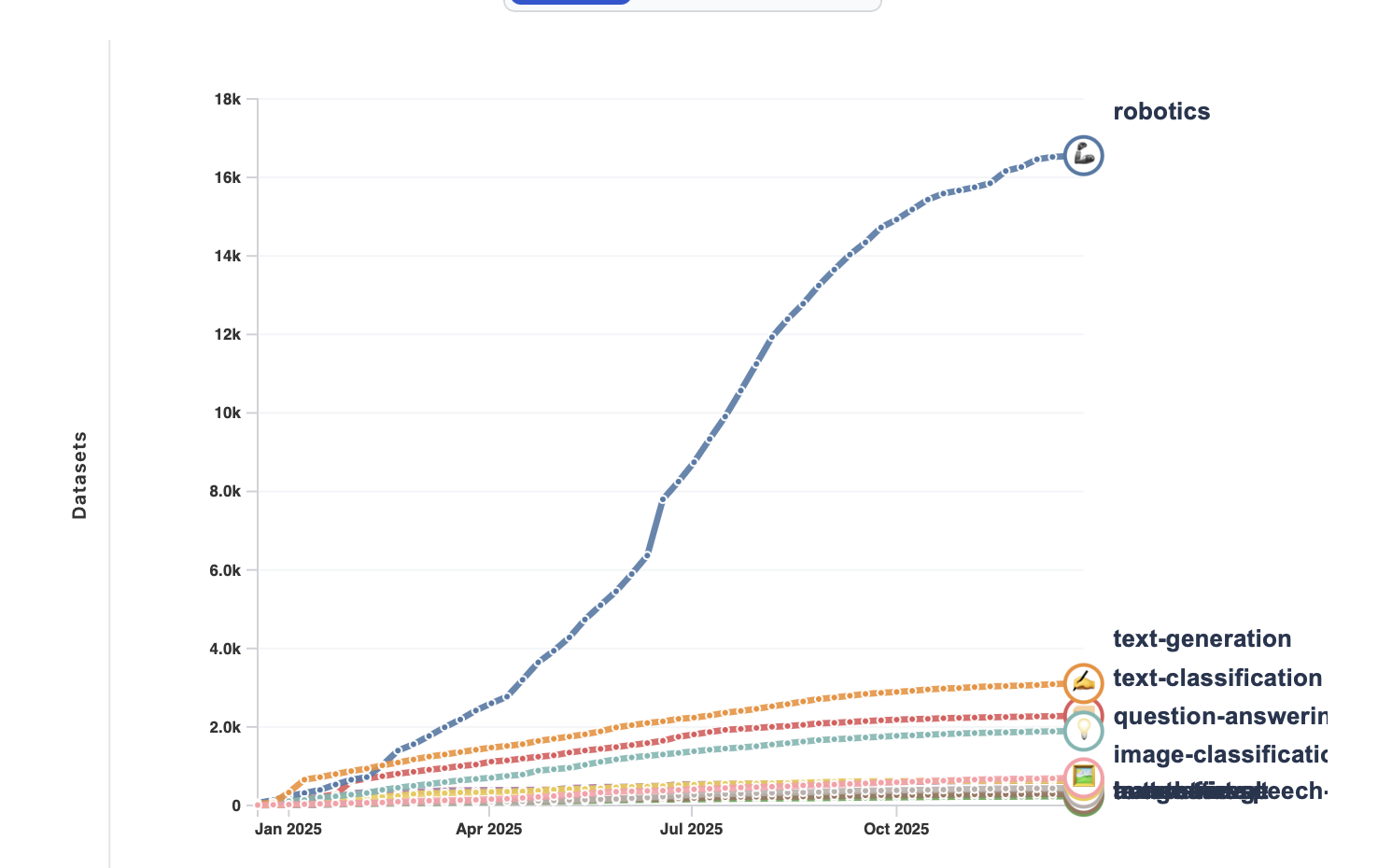 Source: AI World - From the bottom to the top: robotics datasets lead on Hugging Face
This is great news for anyone trying to start a company today (and you should). With a narrow focus on 2026, established companies that have been working on robotics use cases and generating their own data on their own machines are more likely to deploy with impact in the coming year. Especially those focusing on more contained use cases.
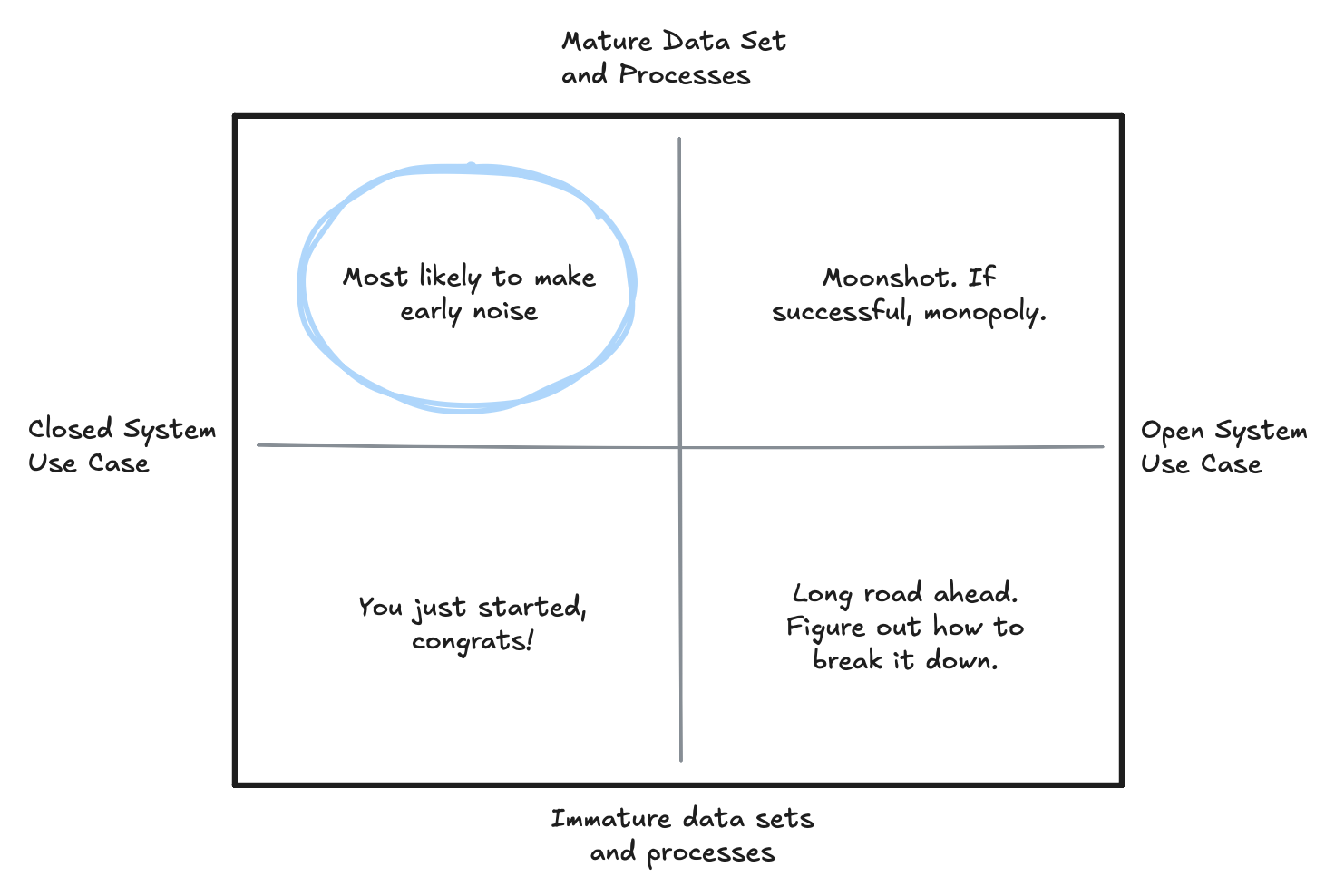
When comparing the various types of use cases, a closed system use case has high degree of control over the environment and more standardize way of interacting with the environment. In contrast, an open system has no control of the environment and interactions are non-standardized.
A good example of more closed system use case could be production line machines — there is a high degree of environmental control and limited / prescribed interaction points. On the other end, humanoid robots deployed in a home would be a highly open system use case. In the middle, a delivery drone service, say from Zipline, would be a slightly less closed system given it operates in the wild and yet still have a higher degree of control over the interaction points. Automated driving like Waymo, Telsa, or Aurora would be a slightly more closed open system use case since you constrain the interactions in the world to roadways.
The business models on this closed-open system axis tend to look a little different as a result too. The more closed the system, the more likely a business will vertically integrate, assume the overseer role, and offer that use case as a (robotic) service. On the other hand, the more open the system, the more likely the robot will be provided to the user to use however desired.
When looking at 2026, the three to four use cases that are most likely to grow in mind share are:
- Automated Delivery — Small Parcels with drones and to lesser extent driverless Freight
- Driverless Car Services — expect 3-5x growth with ~50 million rides in 2026
- Humanoid Pilots — expect to see +10k Optimist, Digit, Atlas, 1X, and Apollo robots in the field with early adopters
- Industrial Class Robotics — large scale machines accelerating industrial projects like solar farm installations and various earthworks tasks in the low thousands could be spotlighted given the strategic importance
I suspect the combination of these use cases, plus the narratives originating from mid-term election campaigns, will lead to robots taking a higher focal point in the overall narrative of progress. It is a third industrial revolution in the making and everyone will try to make it work for them. The more one does, the more others do, the more markets grow and we all live happily ever after till the next Seldon crisis. The only important thing is participation.