This is a mostly agent-controlled repository of my expanded theme of neoidustrialization and drills into the various industry sub-sectors that must scale together. It should be treated sort of as an evergreen primer.
The segments of neoindustrialism
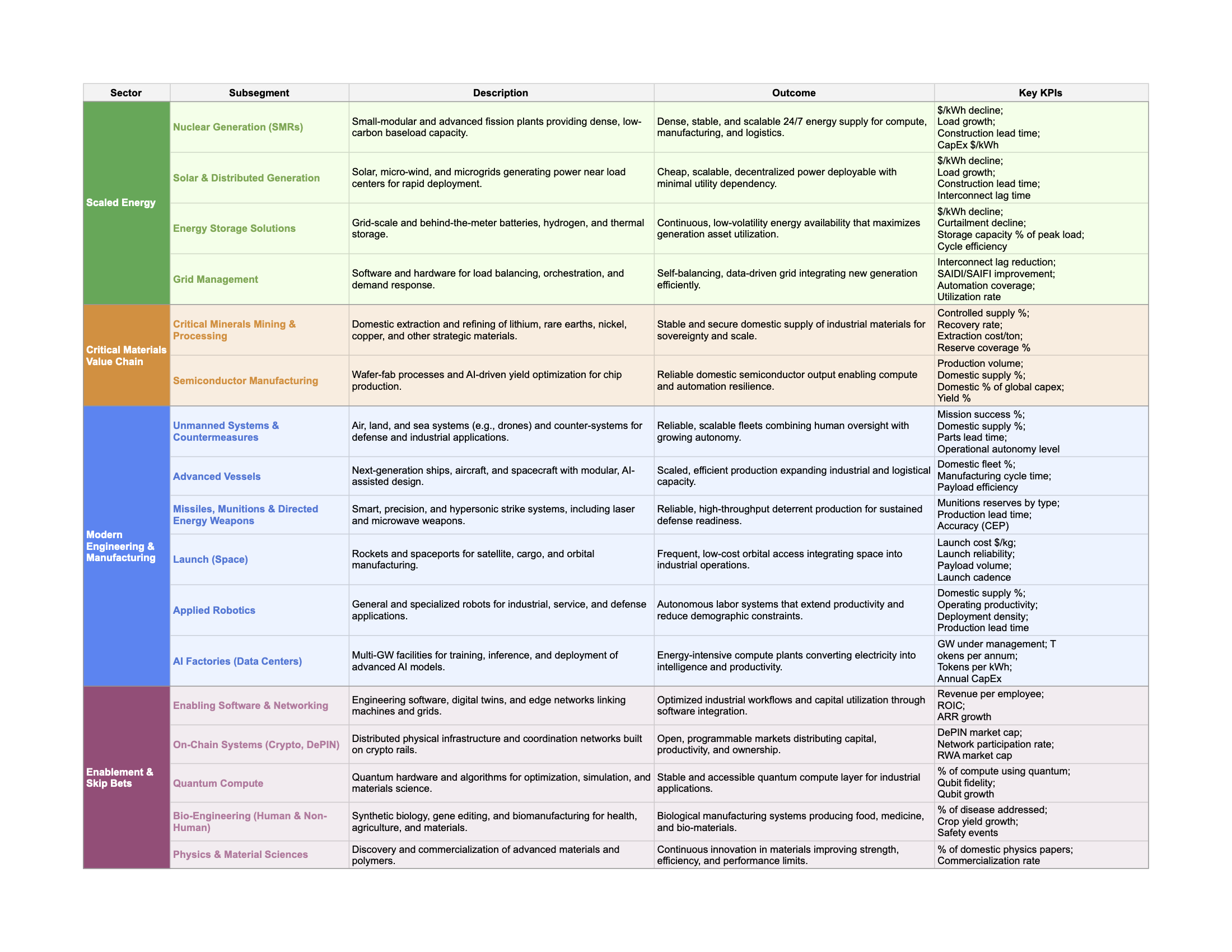
Below is the framework I’m using to map that upgrade into four sectors (and the subsegments inside them). Each sector has a tangible outcome it’s optimizing for, and a handful of KPIs that will tell you—quietly, before the narrative catches up—whether the flywheel is spinning.
The Framework (Four Sectors)
Scaled Energy
Dense, cheap, and scalable power is the prime mover. Everything else — robots, manufacturing, AI data centers - is dependent on available and competitive energy. Think of energy as the inner loop.
Subsegments
- Solar & distributed generation
- Energy storage solutions
- Grid management
- Nuclear generation (SMRs)
Critical Materials Value Chain
If you can’t source, refine, and move the inputs, you can’t scale the outputs. Given the recent underinvestment in these supply chains, I am expecting this to be chokepoint to monitor.
Subsegments
- Critical minerals mining & processing
- Semiconductor manufacturing
Modern Engineering & Manufacturing
This is the face of neoindustrialism and where impact is felt. Generally expect these companies to directly compound the progress of the others, and overtime benefit from vertical integration (e.g., Musk Corp)
Subsegments
- Applied robotics
- Unmanned systems (drones)
- Advanced large vessels
- Missiles, munitions & directed energy
- Launch (space)
- AI factories (data centers)
Enablement & Skip Bets
Software, networks, and frontier science that supports progress. Some of these are the “picks and shovels.” Some are the moonshots that make sense to monitor as AI pulls in timelines. This will not be linear.
Subsegments
- Enabling software & networking
- On-chain systems (crypto, DePIN)
- Quantum compute
- Bio-engineering (human & non-human)
- Physics & material sciences