My X feed for the past week or two has been dominated by Ralph. Ralph loops for this and that. Ralph coin. I tried it and yes, it does move the needle on how I viewed agent progress, although I suspect some less loud engineers were already doing this. What was really powerful about Ralph was less about the tech / Claude setup and more so on how we should be looking at loops.
I like how Jack Clark, Anthropic co-founder, illustrates it almost mundanely in his blog:
These agents that work for me are multiplying me significantly. And this is the dumbest they’ll ever be.
This palpable sense of potential work - of having a literal army of hyper-intelligent loyal colleagues at my command - gnaws at me.
This essay is for those that don’t feel the gnaw and for those that want to signal how much gnaw they have.
History Rhymes, Right?
“Multiplying ourselves.” That’s probably the right way to think about AI / Robotics — which from here out I will refer to broadly as agents; robots will be physical agents after all. When was the last time we multiplied ourselves and what can we learn from it?
It’s not the internet. Fundamentally, the Internet is about connection — more telegraph, telephone, radio type innovations. In contrast, Agents are more for performing functions of work. Which reminded me more of the first and second industrial revolutions.
With broad brushstrokes, the first industrial revolution was defined by machines like the Spinning Jenny or Power Loom which turned skilled crafts into mechanized tasks. The second is a logical extension of the first and is defined most by the factorization of production and the second order innovations that result from gnaw.
Ladies and gentlemen, that gnaw and opportunity is coming again. Time for a framework.
De-specializing Work
Let’s begin with the first industrial revolution and evaluate that transition of work from pre to post mechanization.
Before you have very localized markets and labor pools. Want to build a house? Well you’re getting materials and labor from what we would consider our backyard today. You hire builder families / clans. Most skills are specialized into trades: tailors, farmers, blacksmiths, builders, bankers and so on.
You could broadly categorize this period as “Specialized and Decentralized”. And that’s how I believe our future generations will see the era we have been living in up till now.
The Unfancy Work-System Graph
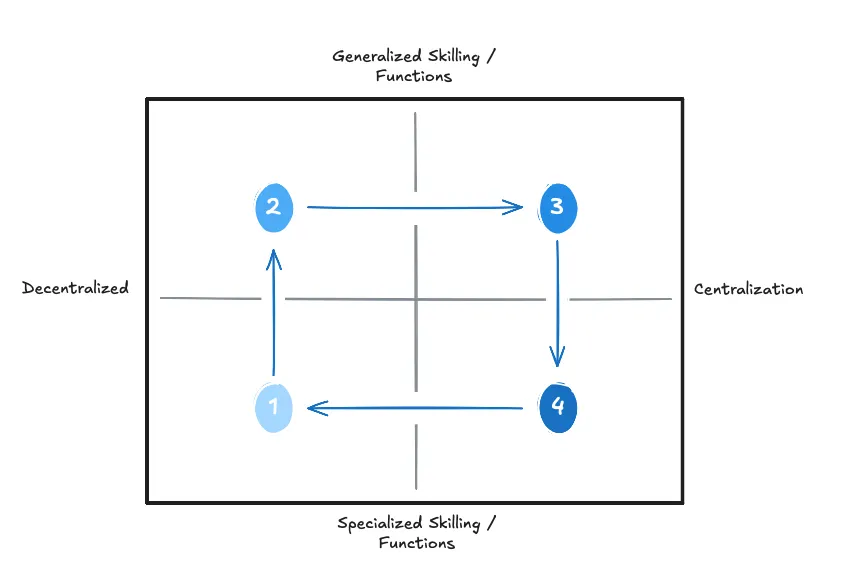
As you start to mechanize those trades, those job families, the trade skill transitions to either generalized task mastering for administering the machines, completing non-mechanized steps, or to higher complexity tasks. Imagine the work loop transition — we start to see the human graduate to above the work loop. Work is compressing.
However, this graduation would diffuse unevenly due to the decentralized nature of the world and economy. It takes time. Generations even. People experiment because there is no prescribed right answer and money was to be made. All you know at the time is there is a machine that can do a task. Do you focus on higher quality goods or compete on price? Improving the machines or use off the rack? What is the right way to design a shop floor? Pause for a second and think about how agents are being applied in markets now.
This period was where the nature of work evolved into much more this master of machines role. And for historians, this played out over 80 years. The second industrial revolution was 50 years if you’re looking for a trend. And it was about integration.
Integrating and Optimizing Systems
As the shift of the role from specialized to generalized machine master occurs, the emerging new incentive becomes scaling these mechanized loops — both vertically and horizontally. Which is no surprise why this era resulted in monopolies and titans. What was it Munger said? “Show me the incentive.”
This phase is rather obvious in hindsight, likely even at the time. Its also the lesson we in the West have taught ourselves for the last few generations. Economies of scale. Standardization. Work centralizes, yes physically into factories and cities, but more importantly into the offices and board rooms of a few.
The key underpinning technologies were steel and energy. Steel of course being stronger, lighter, and manufacturable at scale with Bessemer production processes. Energy with steam power, oil, and later with electricity increases the breadth and scale of production. As a result, you can be audacious, but doing so requires scale, capital, and control of your value chain. So while industry scales, the edge of competition is really between the effectiveness of systems.
Despite the scaling of systems, the nature of work itself remains relatively similar, if not even more generalized as the era progresses. The need remains with the administration of work loops. Think of the typical line worker, dock hand, machine operators. Your job is to keep the system moving. The only notable change is the increasing demand clerical and managerial work — the immaculate birth of middle management.
What you get is chaining and stacking of work loops towards bigger and bigger outcomes. This is how you should view the role of AGI / ASI in relation to agents.
To complete our historical tour de Unfancy Work-Systems Graph, the next era transitions this now generalized work and centralized systems back towards specialized work. Costs are cut. Production and manufacturing is optimized. And we reskill to focus more and more on emerging opportunities and sciences, as you can see with a steady wave of college education that continuously specialized fields of study. This is the era where things feel safest. And as we feel safe and systems optimize, they slowly decentralize to gain additional levels of efficiencies. This is globalization. It is also where we have seen the role of modern startups whom take innovation with shifting organization incentives and deploy with leaner systems and improved outcomes.
And you’re left with this now specialized and decentralized world. It may feel centralized and modern from 2026 looking back 200 years, but from 2050? From 2100? I’d bet we’d appear quite fragmented, just like we were in the early 1700s.
This is a Civilization Loop. It repeats because of this domino of incentives in the game of capitalism. Some participants play the game by the previous square’s rules and lose, some optimize for now and end up doing okay, and then some see what the next set of rules will be and likely end up coming out far better. Each Civ Loop begins with the labor moving above the old work loop. Cue the next episode.
Gnawing the Next Loop
Despite our ability to see ahead, nothing happens over night. It takes time to transition and infuse new technology across multiple actors and markets. However, I suspect each Civilization Loop we get better and faster. If the last took nearly 2 centuries, I’d bet we do the next in just shy of one century. Lots of upheaval and change, but for a society with the attention spans of fish, we will manage.
The Unfancy Work-System Graph for the 21st Century
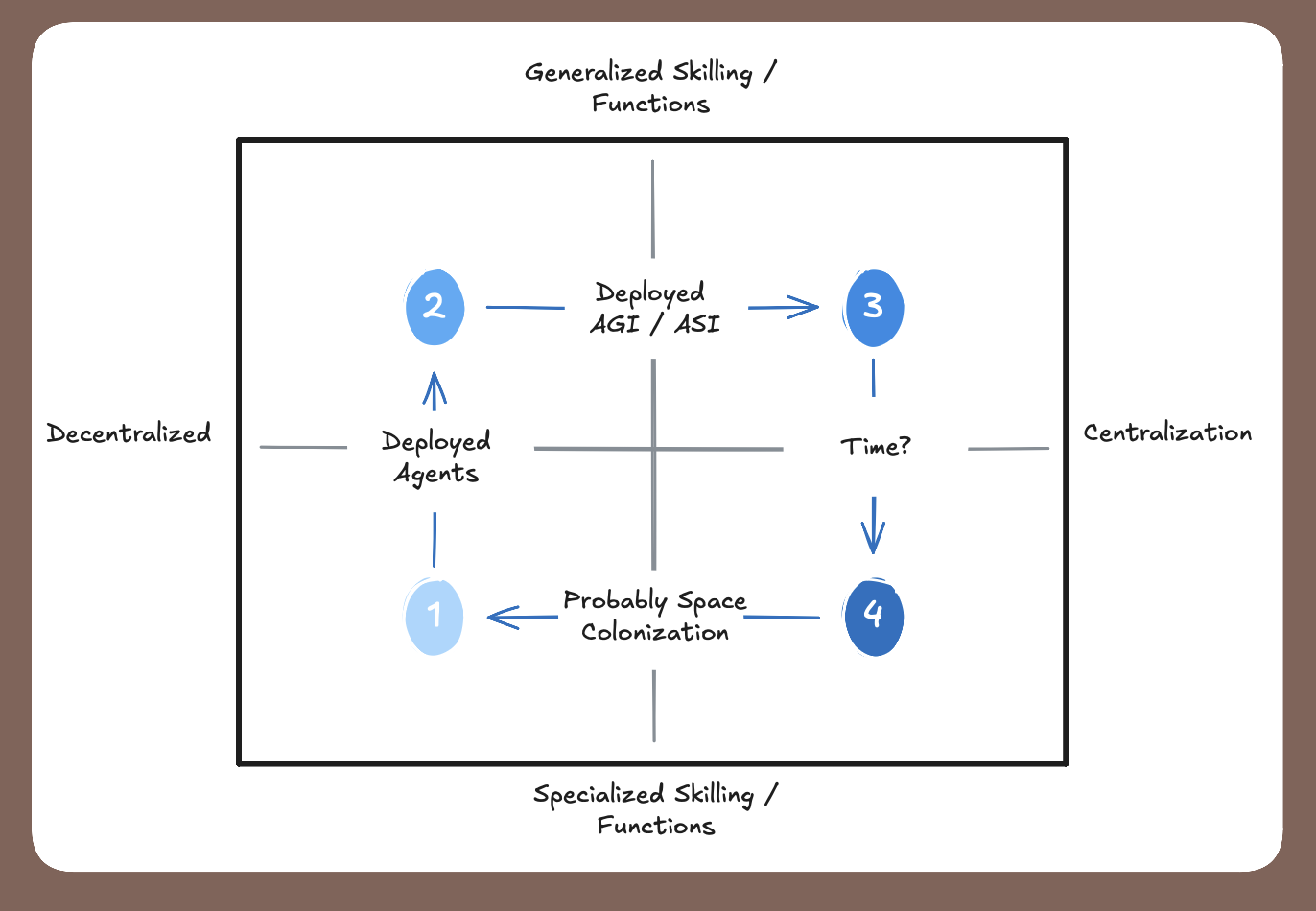
Gnaw. I gnaw at the limitless of this journey. And hell, with Bryan Johnson doing his thing, we might all live long enough to see the full journey.
How do you succeed and prosper? Follow the incentives. We’re sitting in an era of specialized and decentralized. The next epoch rewards generalized skilling — so be a really good generalist. If agents can perform all functions digital and physical, the first problem is deploying those agents in an optimal way across domains. Focus on work loops and outcomes. Think these agents have to reach every corner of industry we exist in. Pick the one you know best and deploy.
The next obvious iteration is how you scale and chain those agents together. For you crypto nerds reading this, this is where decentralized systems (e.g., Bittensor, peaq) likely have the most utility and your coins truly do moon. While the world might be physically very decentralized, your coordination becomes very centralized with AGI / ASI systems and networking will be key. It will allow for a much more efficient economic system. For a little more alpha, go read Accelerando.
From there, who knows what happens. It doesn’t really matter. Likely it results some sort of Star Trek like space colonization in which we will have completed our loop.
Its all about to take off. There is no playbook other than start multiplying yourself and be a really good generalist.
Happy gnawing.